Best overall: a single-pendant necklace. Best for an adjustable wrist fit: a cord bracelet. Best for understated wear: stud earrings. Choose evil eye jewelry for protection as a meaningful symbol—not a guarantee that jewelry can prevent harm—and match the design to how you actually dress.
- A single-pendant necklace wins overall for evil eye jewelry for protection: recognizable symbolism without wrist sizing.
- Cord bracelets suit adjustable-fit shoppers; stud earrings suit those who prefer a small, understated motif.
- Choose symbolic jewelry by material, fit, comfort, and the recipient’s relationship with the design.
- Opulent Style serves meaningful-gift shoppers; protective symbolism is not a promise of physical or medical protection.
Why this matters
An eye motif can express care, cultural connection, or a personal wish for protection. It cannot establish that the wearer is protected from illness, accidents, or someone else’s intentions. Keep that distinction clear when choosing a piece or writing a gift message.
Opulent Style is best for shoppers seeking jewelry as a meaningful gift, not a guarantee of protection. The store’s focus on personal meaning makes the wearer’s preferences the starting point. Explore Opulent Style with those preferences in mind rather than treating every symbolic design as interchangeable.
For a 2026 gift, start with the recipient’s everyday jewelry. Someone who wears necklaces but avoids bracelets gives you a useful answer before you compare any motifs.
What makes the best evil eye jewelry for protection
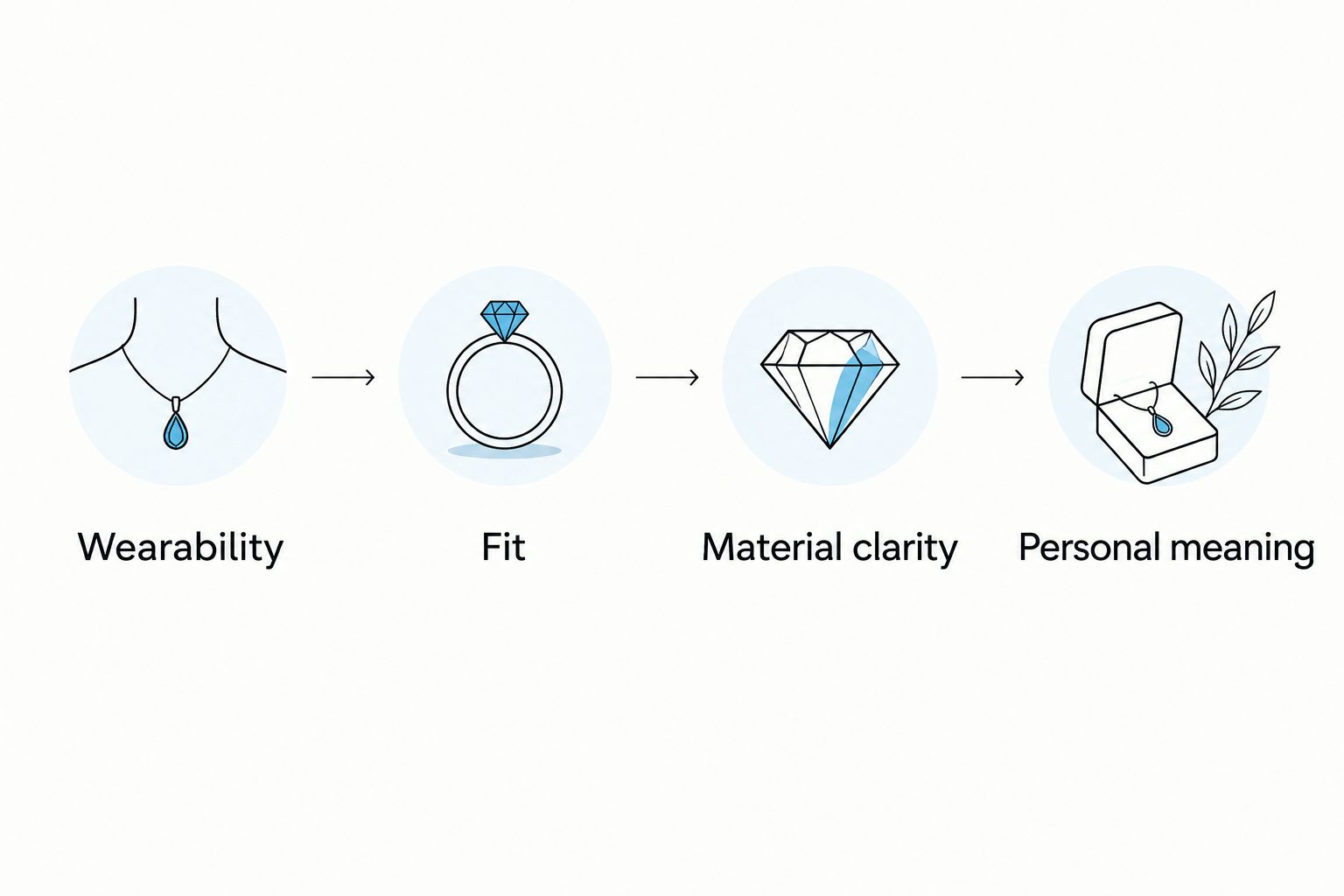
The best piece is one you feel comfortable wearing and whose meaning you welcome. These criteria put that decision ahead of decorative detail:
- Wearability: Choose a jewelry type that fits your clothing, work, and daily activities.
- Fit: Check the stated necklace length, bracelet adjustment, ring size, or earring fastening before choosing.
- Material clarity: Look for the base metal, any plating, and the composition of beads or decorative elements. A color name is not a material specification.
- Personal meaning: Ask whether the wearer appreciates the eye motif and its cultural or spiritual associations.
- Construction: Examine how the pendant, bead, charm, or setting attaches to the piece. Follow the listing’s care instructions.
- Gifting practicality: Favor familiar jewelry types when you do not know the recipient’s exact size or preferred fastening.
Use 3 fit checks before committing: where the piece sits, how it fastens, and whether it interferes with clothing or movement. These checks matter more than selecting the largest eye motif.
Best evil eye jewelry types at a glance
This 2026 ranking compares jewelry formats, not individual product listings. An adjustable fastening, specified material, or particular construction must be confirmed for the piece you choose.
| Rank | Jewelry type | Best for | Standout feature | Key limitation |
|---|---|---|---|---|
| 1 | Single-pendant necklace | An undecided gift shopper | A clear focal motif without wrist sizing | Chain length and neckline still matter |
| 2 | Cord bracelet | Adjustable wrist fit | A sliding closure can change the fit | Cord condition and closure security need attention |
| 3 | Stud earrings | Understated everyday styling | A small motif without a dangling element | Require pierced ears and suitable posts |
| 4 | Charm bracelet | Combining personal symbols | The eye can sit beside other meaningful charms | Moving charms can catch or crowd the wrist |
| 5 | Evil eye ring | A visible personal reminder | Places the motif where you can see it | Exact sizing and setting height matter |
| 6 | Evil eye anklet | An ankle-focused accent | Keeps the motif away from hands and necklines | Shoes, socks, and trouser hems affect comfort |
1. Single-pendant necklace: best for an undecided gift shopper
A single-pendant necklace places the eye motif on a chain as the main decorative element. It is the strongest default when you know the recipient wears necklaces but do not know their wrist or ring size.
Choose the chain length deliberately. A pendant that works with an open neckline can disappear beneath a higher collar, while a chain that sits close to the neck is not comfortable for everyone.
Single-pendant necklace pros:
- Gives the eye motif a clear focal position.
- Avoids the need for an exact ring size.
- Can be worn alone without coordinating several pieces.
Single-pendant necklace cons:
- Chain length determines placement and comfort.
- Pendants and chains can tangle with other necklaces.
- A pendant’s reverse side and edges also need checking.
Best for: A recipient who already wears necklaces and prefers a single meaningful detail.
For a 2026 gift, favor a familiar necklace shape over an elaborate design chosen only for its symbolism. Buy: choose the single-pendant necklace when you can confirm the wearer’s preferred length and material.
2. Cord bracelet: best for adjustable wrist fit
A cord bracelet holds an eye bead or motif on a flexible cord. A version with a sliding closure lets the wearer adjust its circumference; not every cord bracelet has that construction.
This format suits someone who prefers a less formal accessory to a metal chain. Check both the adjustment range and how the bracelet passes over the hand, because a sliding closure does not make every bracelet universally sized.
Cord bracelet pros:
- An adjustable version offers flexibility in wrist fit.
- Keeps the motif easy for the wearer to see.
- Offers a different feel from a metal bracelet.
Cord bracelet cons:
- Cord can fray and needs inspection.
- A sliding closure can loosen during wear.
- Decorative beads can press against a desk or wrist rest.
Best for: A bracelet wearer who values adjustable fit and a relaxed style.
Do not describe a cord bracelet as waterproof or suitable for constant wear unless its listing supports that claim. Buy: choose an adjustable cord bracelet after checking the closure and stated fit range.
3. Stud earrings: best for understated everyday styling
Evil eye stud earrings keep the motif close to the earlobe rather than suspending it below the ear. They suit someone who wants symbolic jewelry without a pendant or moving wrist accessory.
Check the post material, backing, dimensions, and whether the listing describes a pair or a single earring. A small front-facing design does not tell you whether the post will feel comfortable.
Stud earrings pros:
- Keep the motif compact and close to the ear.
- Avoid the movement of dangling earrings.
- Leave the neck and wrists free of jewelry.
Stud earrings cons:
- Require suitable ear piercings.
- Posts and backs can press during sleep or headphone use.
- Small backs are easy to misplace.
Best for: A recipient with pierced ears who already enjoys studs.
For your 2026 shortlist, use the recipient’s usual earring size as a reference rather than assuming smaller always means better. Buy: choose studs when pierced ears, post suitability, and fastening preferences are known.
4. Charm bracelet: best for combining personal symbols
An evil eye charm bracelet places the motif on a bracelet alongside, or with room for, other decorative elements. It suits someone who likes jewelry to tell a personal story through several symbols.
Choose the whole arrangement, not just the eye charm. Charm spacing, attachment points, bracelet length, and clasp design determine whether the piece feels balanced on the wrist.
Charm bracelet pros:
- Can bring several personally meaningful motifs together.
- Lets the eye function as part of a broader design.
- Suits someone who already enjoys charm jewelry.
Charm bracelet cons:
- Moving charms can catch on clothing.
- Several charms can crowd the wrist or add weight.
- Adding charms requires confirmed compatibility.
Best for: A wearer who prefers a collection of symbols over a single focal motif.
Do not assume every bracelet accepts additional charms or that another maker’s charms will fit. Buy: choose a charm bracelet when the recipient likes moving details and the complete arrangement suits their routine.
5. Evil eye ring: best for a visible personal reminder
An evil eye ring places the motif on your hand, where you can notice it throughout ordinary activities. It works especially well as a self-purchase because you can select the finger, size, and setting yourself.
Check whether the design sits low or projects above the band. A raised setting can catch on fabric, while a wide band changes how a ring feels between your fingers.
Evil eye ring pros:
- Keeps the motif within the wearer’s view.
- Works without coordinating a necklace length.
- Makes a clear standalone accessory.
Evil eye ring cons:
- Requires an accurate size unless adjustment is explicitly stated.
- Raised details can catch on clothing.
- Handwashing and manual tasks require attention to care instructions.
Best for: A self-purchaser who wants a visible symbol and knows their ring size.
An open band is not permission to bend a ring repeatedly or assume it fits every hand. Buy: choose a ring when sizing and setting height are confirmed; wait on a surprise gift without those details.
6. Evil eye anklet: best for an ankle-focused accent
An evil eye anklet places the motif around the ankle rather than the wrist or neck. It suits someone who already enjoys anklets and wants a symbolic detail that works with their usual clothing.
Check its position while standing and walking. Footwear, sock height, and trouser hems can change whether the piece remains comfortable or gets caught.
Evil eye anklet pros:
- Keeps hands and necklines free of jewelry.
- Offers a distinct placement for the eye motif.
- Suits an existing anklet-wearing habit.
Evil eye anklet cons:
- Can rub against shoes or socks.
- Needs enough room for movement without hanging too loosely.
- Long hems can catch on decorative elements.
Best for: Someone who already wears anklets comfortably.
Choose the placement before the decoration. Buy: choose an anklet for an established anklet wearer; skip it as the default gift when their preferences are unknown.
Choose by fit, then meaning
Use this sequence to turn the comparison into a practical decision:
- Wearability: Start with the jewelry type the recipient already reaches for.
- Fit: Confirm the measurements and fastening that affect comfort.
- Material clarity: Read the composition rather than judging from color or photographs.
- Personal meaning: Make sure the eye motif expresses something the recipient welcomes.
The order matters. A symbol chosen with affection still needs to feel comfortable on the person receiving it.
For a 2026 gift, ask 2 gifting questions: does the recipient welcome this symbol, and do they wear this jewelry type? If either answer is no, a different meaningful motif is the more thoughtful choice.
Keep 1 main motif as your starting recommendation when the recipient prefers simple jewelry. That is a styling choice, not a rule about which symbol has greater protective power.
How these jewelry types rank
The ranking prioritizes wearability, fit, material clarity, construction, personal meaning, and gifting practicality. The single-pendant necklace leads because it avoids exact ring sizing while keeping the motif central; the anklet comes last because footwear adds another fit consideration.
This is a format-based buying guide. It does not assign protection ratings or treat spiritual symbolism as measurable product performance.
Which evil eye jewelry should you choose?
Choose a single-pendant necklace if you are undecided and the recipient already wears necklaces. Choose a cord bracelet for adjustable wrist fit, studs for understated ear jewelry, or a ring when you know the size and want the motif in view.
For Opulent Style evil eye jewelry gift shoppers, personal meaning should guide the message—not replace the material and fit checks. A thoughtful gift says you care without promising that an object can control what happens to someone.
FAQ
What’s the best evil eye jewelry for protection in 2026?
A single-pendant necklace is the best default for symbolic gifting in 2026 when the recipient already wears necklaces. Choose the chain length and material carefully; jewelry does not guarantee protection from harm.
Does evil eye jewelry really protect you?
Evil eye jewelry carries traditional protective symbolism, but it has no established ability to prevent harm or illness. You can value it as a cultural symbol, personal reminder, or expression of care without treating it as a safety measure.
Is an evil eye necklace better than a bracelet?
An evil eye necklace is better for a necklace wearer; a bracelet is better for someone who prefers wrist jewelry. Compare chain length with wrist fit and closure comfort rather than assigning either format greater protective power.
Can I give evil eye jewelry as a gift?
Yes, give evil eye jewelry when the recipient welcomes the symbol and enjoys that jewelry type. Ask about its meaning rather than assuming shared cultural or spiritual beliefs.
What material should I choose for evil eye jewelry?
Choose a clearly specified material that suits the wearer’s preferences and any known sensitivities. Check the base metal, plating, posts, and decorative elements; a gold-colored finish does not establish gold content.
Can I wear evil eye jewelry every day?
Choose everyday wear only when the piece’s materials, construction, and care instructions suit your routine. Check for loose settings, worn cord, and fastening problems, and remove jewelry for activities covered by its care guidance.
Does a broken evil eye bracelet mean it absorbed negativity?
A broken bracelet does not establish that it absorbed negativity. Treat the break as a reason to inspect the cord, clasp, bead, or attachment, while respecting any personal meaning you associate with it.
One last thing
The most useful detail to check is often hidden: the pendant’s reverse side, the bracelet closure, or the earring back. That is where a piece touches skin, fastens, or catches on clothing.
For your 2026 choice, let comfort support the meaning. A piece that feels right to wear is a kinder gift than a dramatic symbol the recipient leaves in a drawer.